Introduction
The CHESS Analysis Pipeline (CHAP), depeloped at the Cornell High Energy Synchrotron Source (CHESS), is an object-oriented python framework for refactoring monolithic data
analysis programs into modular pipelines composed of interchangeable, reusable code components. The basic
blueprint for a Pipeline component consists of a Reader, Processor, and Writer, as shown in the diagram below:
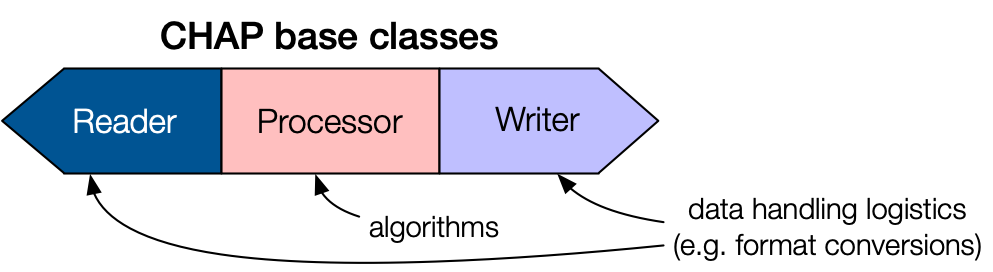
The basic blueprint of a CHAP pipeline component.
The Reader and Writer base classes handle data input and output for a Pipeline component, respectively. These base classes encapsulate the CHESS-specific logistics, such as file operations and data format conversions and validate their data with the Pydantic library. They isolate a Pipeline’s I/O functions from its data analysis algorithms, allowing a single algorithm to accept multiple data formats.
Inherited subclasses are defined for specific file types, e.g. H5Reader, NexusWriter. A single Pipeline component may contain multiple Readers or Writers.
The Processor base class encapsulates the data analysis algorithm. Because Processors are independent of
CHESS infrastructure, researchers can easily contribute Processor subclasses
with bespoke data analysis code. Readers and Writers pass data into and out of Processors via PipelineData containers.
Multiple Processors can be chained together within a single Pipeline component.
Workflows are defined by CHAP configuration files written in YAML. Each file may contain one or more
Pipeline components that can be executed individually or all at once (sequentially or in parallel). The diagram below shows
a schematic workflow with series of Pipeline components linked together in a single configuration file.
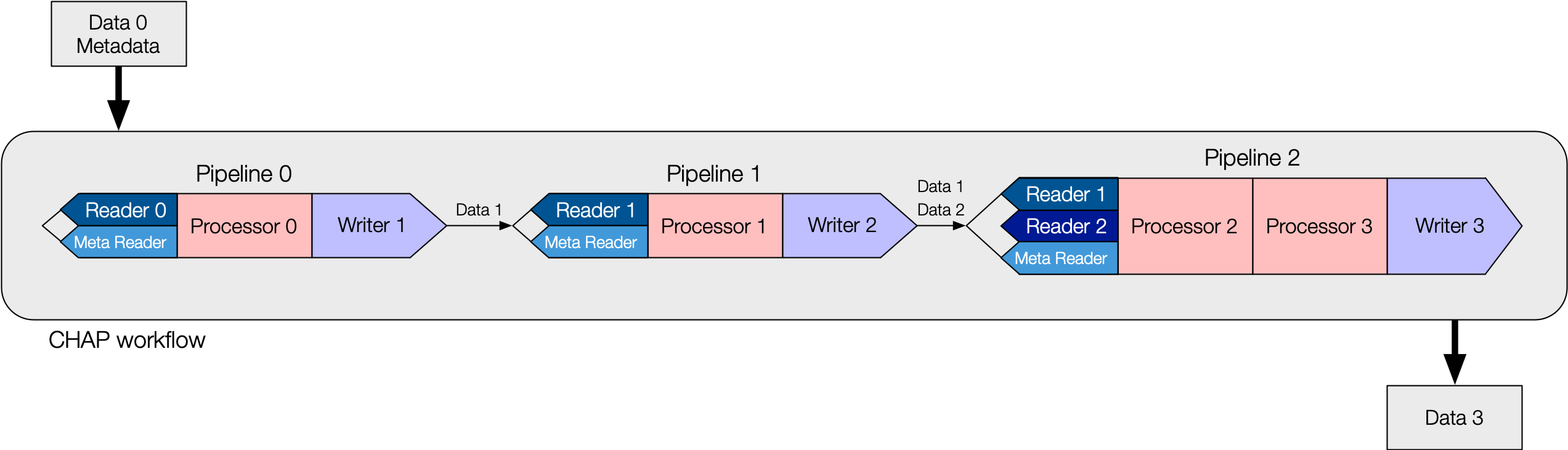
An example of a CHAP workflow consisting of three Pipeline components.
Workflows for specific X-ray techniques are constructed from concrete implementations of the CHAP base classes.
For example, in the EDD workflow example pipeline file,
“energy” is for energy calibration with “Processor 0” being edd.MCAEnergyCalibrationProcessor,
“twotheta” is for detector theta calibration with “Processor 1” being edd.MCATthCalibrationProcessor, and so on.